
You Have Another
WriteInRalph.com is an independent grassroots project helping South Carolina Voters understand the write-in option for Ralph Norman.
How Did We Get Here?
A Senate vacancy. A compressed special election. And a choice South Carolina voters can still make.
Lindsey Graham Dies
What happened:
Sen. Lindsey Graham unexpectedly dies at age 71, leaving his U.S. Senate seat vacant just weeks after winning the Republican nomination for another term. His death triggers an unusual, fast-moving process to replace him on the November ballot.
Why it matters:
South Carolina is suddenly pushed into an extraordinary and extremely compressed election process that no candidate had been preparing for.
Darline Graham Appointed
What happened:
Gov. Henry McMaster appoints Lindsey Graham’s sister, Darline Graham, to temporarily fill the vacant Senate seat through January 2027. Earlier that day, President Trump publicly called for her appointment.
Why it matters:
The appointment immediately gives one potential candidate the title and visibility of a sitting United States senator before the special-primary filing period even begins.
Appointment Becomes Candidacy
What happened:
Days after her appointment, President Trump endorses Darline Graham for a full six-year term and says he asked her to enter the race. Graham soon announces that she will compete in the special Republican primary.
Why it matters:
Within nine days of Lindsey Graham’s death, the appointed senator has the backing of the president and is running for the full six-year term.
A One-Week Filing Window
What happened:
Candidates have only July 21st through July 28th to file, with the special primary scheduled for August 11th.
Why it matters:
The entire statewide campaign is being assembled in weeks rather than months. The concern is a schedule that compressed can disproportionately benefit candidates who begin with immediate name recognition, national support, institutional access or signifigant resources.
A New GOP Rule Becomes Part of the Race
What happened:
A new SCGOP rule that took effect July 1st required candidates to have voted in at least two of the previous three statewide Republican primaries. Three Senate candidates were initially denied certification under party qualification rules. Darline Graham was certified; the party said her participation in the 2024 Republican runoff and 2026 primary satisifed the rule.
Why it matters:
The rule was only weeks old when an unexpected statewide special election occured, and its interpretation immediately became controversial. Critics questioned whether candidates were being treated consistently.
The Candidate Rules End Up in Court
What happened:
Danny Ford challenged his exclusion. A circuit court ordered him onto the ballot. When the SCGOP and Election Commission sought to stop that order, the South Carolina Supreme Court allowed the election to continue with Ford included because voting was already underway and further changes risked greater voter confusion. Importantly, the Supreme Court did not decide the underlying merits of the party rule itself.
Why it matters:
The qualification dispute became serious enough that ballots were changing while early voting was already beginning. The Supreme Court itself noted the risk of voter confusion.
Voters Force a Runoff
What happened:
Ten Republicans compete in the special primary. Graham finishes first with about 33%, Ralph Norman second with about 25%, Russell Fry third with about 20%, and Mark Sanford fourth with about 15%. Roughly two-thirds of Republican voters chose someone other than Graham, sending the race to a head-to-head runoff.
Why it matters:
Graham finised first, but the majority of Republican voters chose someone else. That meant the primary was not a clear mandate – it was a fragmented field that pushed the decision into a head-to-head runoff. For voters already concerned about the rushed timeline, outside influence and advantages built into the race, the runoff became the first real opportunity to directly compare Graham to Ralph Norman without eight other candidates dividing the vote.
National Money and Influence Flood the Runoff
What happened:
Trump personally campaigns for Graham, while MAGA Inc. – the super PAC supporting Trump – spends more than $800,000 on the final day alone supporting her. Graham ultimately defeats Norman by roughly 52.4% to 47.6%.
Why it matters:
Supporters of the outcome can reasonably view this as normal political support. Critics see it as evidence of how dramatically national political power and money shaped an unusually short South Carolina election.
The Final Decision Belongs to Voters
Darline Graham and Democrat Annie Andrews appear as the major-party choices — but South Carolina voters are not limited to the names printed on the ballot. The general election also provides a write-in option.
Why We’re Questioning This
No single event proves that this election was illegitimate. That isn’t the claim. But taken together, the family succession, a brand-new and contested party rule, an extraordinarily compressed election calendar, national political intervention, outside money and a major imbalance in national media attention raise questions we believe South Carolinians have every right to ask. Was this truly an open, voter-driven contest – or did too many advantages accumulate around one candidate before voters ever had a meaningful opportunity to evaluate the field?
A Senate Seat That Looks Inherited
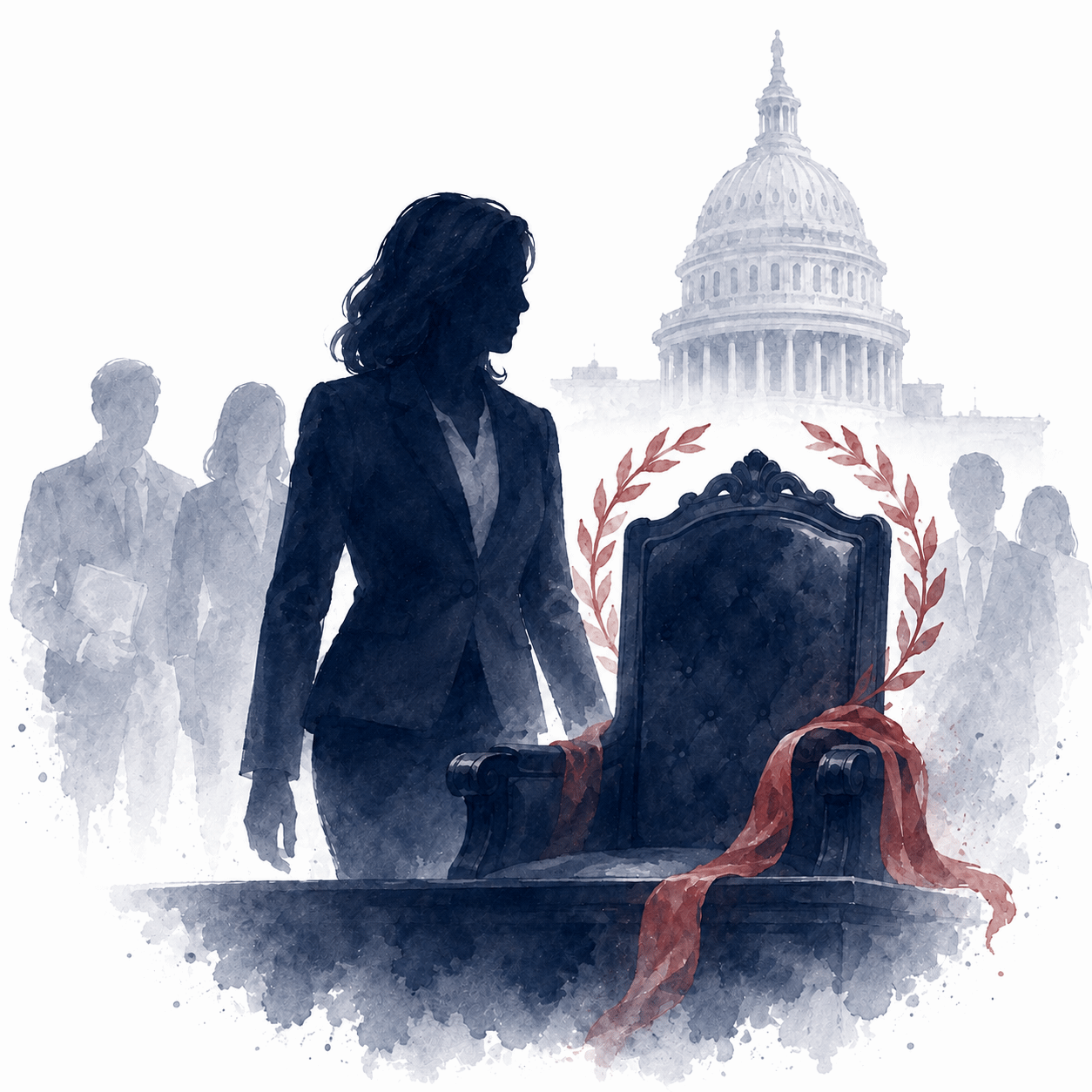
Darline Graham’s appointment was legal – but legality does not erase questions about appearance, influence, and political-inheritance. After Lindsey Graham’s unexpected death, Gov. Henry McMaster appointed Lindey’s sister to his senate seat only hours after President Trump publicly recommended her for the position. She had never previously held elected office.
The symbolism was difficult to ignore: when her appointment was announced, dozens of Lindsey Graham’s staffers and campaign advisers stood behind her. Federal Senate rules also provide continuity for a deceased senator’s employees, who can remain on the Senate payroll for up to 60 days while the office transitions. Those staff members are public employees, not elected officials and the voters never directly chose them.
Our concern is not that continuity itself is improper. It is that a family member stepping directly into the seat – alongside the name recognition, office infrastructure, political relationships and institutional continuity of her brother – can make a public office feel less like an open vacancy and more like an inheritance or coronation. A United States Senate seat belongs to South Carolina, not to any family.

A New Rule and Questions About How It Was Applied
Only weeks before the special election, the SCGOP adopted a new candidate-eligibility rule requiring candidates to have been registered Republicans for at least 90 days and to have voted in two of the three statewide Republican primaries. The rule took effect July 1st. Lindsey Graham died July 11th. Candidate filing began only ten days later.
Then came the controversy.
Danny Ford II was denied certification under the rule. Ford argued that he had voted in both the June 9th Republican primary and the June 23rd runoff; the party said those counted as one primary cycle, not two. Darline Graham, meanwhile, was certified because the SCGOP interpreted her participation in the 2024 and 2026 Republican cycles as satisfying the requirement. Party leadership maintained that the rule was applied consistently. Critics questioned whether the wording and interpretation were sufficiently clear and consistently applied.
The dispute became serious enough to reach the courts. Ford ultimately remained on the ballot, although the South Carolina Supreme Court expressly did not decide the underlying merits of the rule when it declined to disrupt an election already underway.
Our concern is simple: when a brand-new rule can determine who voters are even permitted to consider – and its interpretation becomes disputed while ballots are already being prepared – the public deserves complete transparency and absolute confidence that everyone was judged by the same standard.

An Election Measured in Weeks, Not Months
Lindsey Graham died on July 11th. Candidate filing ran only from July 21st through July 28th, and the Republican primary occured August 11th. Candidates were attempting to organize statewide campaigns almost overnight.
That matters because time is one of the great equalizers in an election.
Given months, an unknown candidate can travel the state, introduce themselves to voters, raise money, earn endorsements, participate in interviews and debates, and gradually overcome another candidate’s initial advantages.
In a race measured in weeks, those starting advantages become enourmously more valuable.
Name recognition matters more. Incumbancey matters more. Major endorsements matter more. Existing donor networks matter more. National money matters more. And media attention matters much more.
A compressed election does not automatically make an election unfair. But it magnifies every advantage a candidate already possesses and makes it considerably harder for voters to become equally familiar with a large field of alternatives.

National Power, Money and Media Attention
The race did not remain simply a South Carolina contest. President Trump publicly recommended Darline Graham for the Senate appointment, urged her to seek the full term, endorsed her campaign and later personally campaigned for her. National political organizations and outside money also became heavily involved.
But money and endorsements were only part of the advantage.
Our own audit of strictly candidate-focused media coverage from July 11th through August 9th found an extraordinary imbalance at the national level. Darline Graham recieved 12 of the 19 dedicated national candidate stories, interviews, profiles and campaign features we identified – about 63% of all dedicated national coverage in a ten-candidate field.
Ralph Norman recieved four. Mark Sanford recieved two. Russel Fry recieved one. Every other candidate recieved zero dedicated national pieces in the audit.
Media organizations are free to decide whom they cover. But coverage creates name recognition, legitimacy and familiarity – and in an election lasting only a few weeks, that exposure can be enormously valuable. When one candidate receives nearly two-thirds of the dedicated national attention in a field this large, we believe that imbalance deserves to be acknowledged rather than ignored.
None of this proves an election was “rigged”. Questioning a process is not the same as claiming it is illegal. We’re not asking anyone to accept a conspiracy theory. We are asking South Carolinians to look at the sequence of events, examine the sources and decide for themselves whether this was the kind of open, competitive, voter-driven election process they want for their state.
By the people, for the people
This isn’t about parties. It’s about principle, representation and the freedom to choose the leader you believe will best serve South Carolina. If the system takes a choice off the ballot, we the people can still write it in.

Fact vs. Fiction
Let’s clear up a few things about write-in voting.
Claim
“A write-in vote is a wasted vote.”
Fact
A properly cast write-in vote is a lawful vote and is counted as a vote for the person whose name was entered. South Carolina specifically provides a write-in option for U.S. Senate.
Claim
“Writing in Ralph is literally a vote for Annie Andrews.”
Fact
Votes aren’t transferred between candidates. A vote entered for Ralph Norman is counted as a write-in vote — not as a vote for Annie Andrews or Darline Graham.
Claim
“Ralph lost the primary, so write-in votes for him can’t count.”
Fact
South Carolina does prohibit a defeated primary candidate from actively campaigning as a write-in candidate. But that is not the same as invalidating votes citizens independently cast for that person.
Claim
“Ralph Norman has to approve this.”
Fact
This website is an independently created citizen project. It does not claim to be Norman’s campaign, and its existence does not imply his authorization or participation.
Claim
“You can’t write someone in on South Carolina’s voting machines.”
Fact
You can. For U.S. Senate, voters can select Write-In, type the person’s name using the touchscreen keyboard, and press Accept. Paper ballots also provide a write-in line.
Why Ralph Norman?

Ralph Norman is the name on the write-in line, but this movement is about something much bigger than one man.
It’s about every South Carolinian who believes their voice still matters, their vote still belongs to them, and they don’t have to simply accept the choices handed down by the political establishment.
In that sense, we are all Ralph. This is about standing up, speaking out, and reminding those in power that the final decision still belongs to the people.
Heritage Action Lifetime Rating
The Club for Growth Lifetime Rating
Liberty Score

Constitutional Conservative
Ralph consistently stands for limited government, strong borders and individual liberty.

Proven Record of Service
He’s a citizen, businessman and public servant who puts South Carolinians first.

Fights for Our Values
Norman defends our Second Amendment, supports secure elections and champions our way of life.
Join the Conversation.
Connect with other patriots, discuss the issues, ask questions, share reliable sources, and get the latest updates on the Write In Ralph effort.

Election Day – Tuesday, November 3rd
Write-In FAQ

Stay Informed
Get updates on the write-in effort, election information, source documents and myth-busting content.
Independent Grassroots Project. No spam. Unsubscribe anytime.