
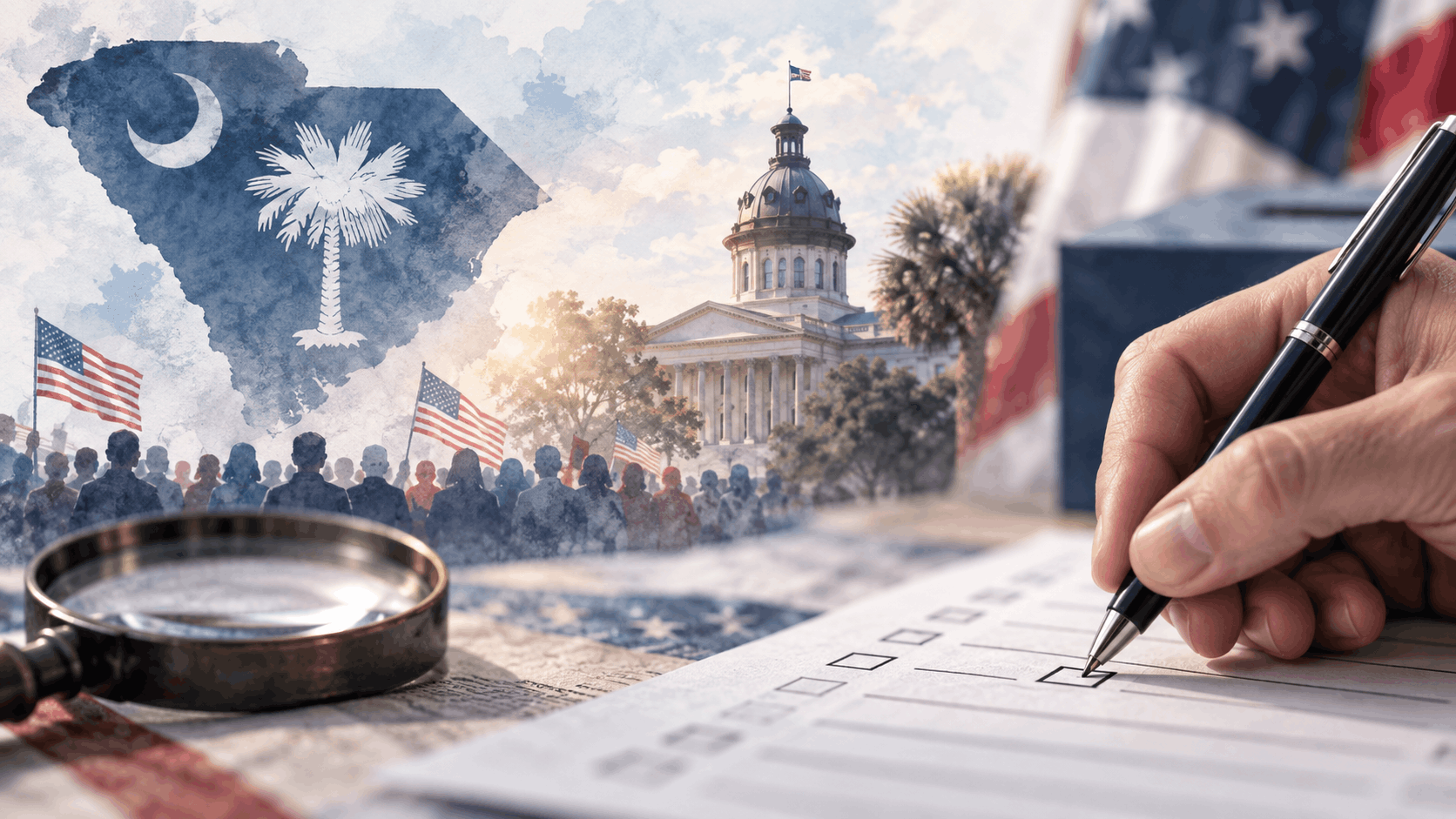
For years, election integrity has occupied a central place in Republican politics.
The Republican Party's 2024 platform devoted an entire pillar to the subject, promising to “ensure election integrity” and advocating policies intended to increase confidence in American elections. Whatever one thinks of the individual policies proposed under that banner, the underlying message has been unmistakable: elections matter, the rules matter, and voters should have confidence that their voices matter.
That principle raises an uncomfortable question in South Carolina today.
What happens when voters exercise their lawful political rights in a way the party establishment does not particularly like?
The grassroots effort encouraging South Carolinian's to consider writing in Ralph Norman for U.S. Senate has been criticized as divisive and potentially beneficial to Democrats. Those are political arguments that people are entitled to make. But a different kind of accusation sometimes appears in conversations surrounding the movement: that a grassroots write-in effort must somehow be a Democratic operation or an attempt to sabotage Republicans.
That is a much more serious claim, and serious claims should require serious evidence.
The folks behind the Write In Ralph movement are independent conservatives coming together because they feel wronged, none of us are affiliated with Ralph Norman's campaign and nothing you see here is authorized or coordinated by Norman, his campaign or a political party. Criticism of this movement is fair game. Questions about its consequences are fair game. But evidence should remain the standard before allegations about hidden political coordination are treated as fact.
There is also an important distinction that seems increasingly lost in partisan politics: accepting an election result is not the same thing as surrendering one's political judgment afterward.
Darline Graham won the Republican runoff against Ralph Norman. That is the result of the Republican nominating process. Acknowledging that fact does not answer a separate question: what obligations, if any, does a voter have after the primary is finished?
A party nomination determines who receives a party's place on the ballot. It does not transfer ownership of an individual's vote to that party.
South Carolina law itself recognizes that distinction. The South Carolina Election Commission states that write-in voting is permitted in general elections for offices other than president and vice president, and the state's election code requires general-election ballots to contain a place for write-in votes.
There is an important limitation: a candidate defeated in a party primary may not personally offer or campaign as a write-in candidate in the ensuing election. The Election Commission explicitly notes that restriction. But that restriction is different from saying citizens lose their ability to cast write-in votes.
That difference matters.
The argument surrounding the South Carolina Senate race therefore reaches beyond Ralph Norman, Darline Graham or even this particular election. It touches a larger question about political participation.
Does voter sovereignty end when a primary ends?
Critics of the write-in effort have a straightforward argument. Graham won the Republican nomination, and a significant write-in effort among conservative voters could divide voters who might otherwise support the Republican nominee. That possibility is one reason opponents describe the movement as counterproductive.
Supporters see something different. They argue that political parties exist to represent voters — not the other way around — and that the ability to reject the choices presented by political institutions is itself part of meaningful political participation.
It is also impossible to separate the controversy from the unusual circumstances that produced this election.
Governor Henry McMaster appointed Darline Graham to the United States Senate on July 13th following the death of her brother, Sen. Lindsey Graham. Before that appointment, she had served since 2019 as commissioner of the South Carolina Commission for the Blind. She later defeated Norman in the Republican runoff and became the party's nominee.
None of those facts makes her appointment illegitimate. South Carolina's governor had the authority to fill the vacancy.
But legality does not eliminate political debate.
Voters are allowed to ask whether family relationships should carry political significance. They are allowed to compare résumés. They are allowed to examine political networks, endorsements, campaign spending and institutional support. And they are allowed to decide how much weight each of those things deserves.
Norman entered the race with years of legislative experience, while Graham entered it with a different public-service background. AP reported during the runoff that Norman made his congressional experience and Graham's relative lack of elected experience central issues in his campaign.
Money became part of the discussion as well. Graham's principal campaign committee reported $346,782.64 in receipts between July 23 and August 5, while outside groups separately spent money in the race; AP reported that the pro-Trump MAGA Inc. super PAC spent nearly $830,000 supporting Graham.
That does not prove anyone “bought” a Senate seat. Campaign spending and independent political expenditures are ordinary and regulated features of American elections.
But citizens are equally entitled to question the influence of money and political institutions on the process.
Perhaps that is where the most useful meaning of election integrity can be found.
Election integrity is usually discussed in terms of ballots, identification requirements, eligibility, machines and vote counting. Those are important questions. But there is another democratic principle nearby: the idea that political authority ultimately flows from citizens rather than institutions.
A political party can nominate a candidate.
A governor can lawfully appoint a senator.
Political action committees can spend money advocating for candidates.
Presidents, governors, senators and party leaders can make endorsements.
And voters can listen to every one of them.
But none of those actors owns the vote that eventually gets cast.
That is why accusations surrounding a grassroots political movement deserve the same standards of evidence conservatives routinely demand elsewhere. Calling an unpopular position a “Democrat operation” does not make it one. Calling dissent disloyalty does not resolve the argument behind the dissent.
Nor does acknowledging the legitimacy of the Republican primary require pretending that every Republican voter must reach the same conclusion in November.
There is a difference between respecting an election and surrendering the right to continue questioning the political process.
South Carolinian's can disagree sharply over Norman, Graham, the write-in movement and the consequences of dividing conservative voters. That debate is legitimate.
But perhaps the more enduring question is one that extends well beyond November:
If election integrity means that every lawful vote deserves to be counted, shouldn't political integrity also mean respecting the voter's right to decide where that vote belongs?