Communism is back in American political vocabulary.
Heading into the 2026 midterms, President Donald Trump and other Republican leaders have increasingly presented the election as a struggle against communism. Trump has described Democrats as communists and warned that Democratic victories would move the country in that direction. The Associated Press reported this summer that Vice President JD Vance and House Speaker Mike Johnson had employed similar themes, although experts interviewed by AP disputed characterizing the Democratic Party broadly as communist.
The message fits naturally within Republican tradition. The party's 2024 platform opens by celebrating America's eventual triumph over Soviet communism after the Cold War.
There is nothing particularly surprising about Republicans opposing communism.
But there is an interesting question hiding underneath all of this rhetoric.
What exactly are we defending when we say we are defending America from communism?
If the answer includes individual liberty, decentralized political power, open disagreement and the right of citizens to make independent political choices, then those principles become meaningful not merely when confronting the opposing party.
They also matter when disagreement comes from inside our own.
First, Let's Be Clear About What Communism Actually Is
Political language becomes considerably less useful when every practice we dislike becomes “communism.”
The current Communist Party USA program calls for social ownership and control of major sectors of the economy, nationalization of key industries and replacing capitalist competition with a strategically planned economy. Interestingly, the modern CPUSA also says it intends to compete in contested elections.
Historically, Leninist communist parties also developed an organizational principle known as democratic centralism. Members could debate internally, but once the organization made a decision, the emphasis shifted toward centralized leadership, party discipline and unified action. Early Communist International rules called for strongly centralized organizations in which parliamentary members and party publications ultimately answered to central party leadership.
That history does not mean ordinary party discipline in America is equivalent to Leninism. Democrats, Republicans and virtually every successful political organization value unity after internal disagreements.
The comparison becomes interesting somewhere else.
It is the philosophical question of how much independence a political movement is willing to tolerate once leadership has made its preference known?
Anti-Communism Has Faced This Question Before
That question is hardly new to Republican politics.
In 1950, Sen. Joseph McCarthy of Wisconsin became nationally famous by alleging communist infiltration of the federal government. There were genuine espionage cases and legitimate American concerns about Soviet activity during the period. But McCarthy increasingly made allegations whose evidentiary basis was disputed.
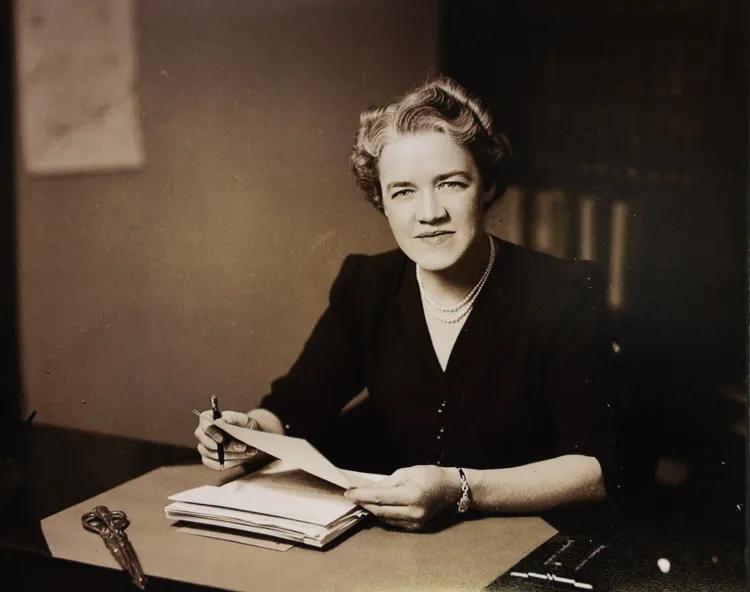
One of the Republicans who became uncomfortable with his methods was Maine Sen. Margaret Chase Smith.
Smith was no communist sympathizer. She was a Republican, an anti-communist and initially believed McCarthy might have uncovered something significant.
According to the Senate's own history, she began turning against his methods after repeatedly asking to see the evidence supporting his allegations and finding that it did not substantiate many of the charges he was making.
On June 1, 1950, Smith walked onto the Senate floor and delivered what became known as her Declaration of Conscience.
At the heart of that speech was a remarkably simple definition of American political freedom:
“The right to criticize. The right to hold unpopular beliefs. The right to protest. The right of independent thought.”
That passage may be more relevant today than any particular argument over whether McCarthy himself was right or wrong about an individual accusation.
Smith's point was that opposing communism did not excuse abandoning the political freedoms that supposedly distinguished America from the system it opposed.
She was particularly concerned about her own party.
Smith argued that Republicans had legitimate issues on which to challenge Democrats and therefore did not need unsubstantiated accusations or political smears. She warned her Republican colleagues against pursuing victory through fear and political exploitation and argued that a political party capable of criticizing its opponents also had to tolerate criticism of itself.
There is wisdom in that distinction.
One can oppose communism while also opposing the use of anti-communism as a demand for conformity.
Indeed, Smith viewed those positions as complementary.
Now Bring That Question to South Carolina
That brings us to the considerably smaller stage of South Carolina politics.
The special Republican Senate election unfolded under unusual circumstances and on an extremely compressed schedule. Darline Graham entered the race with President Trump's endorsement and substantial institutional support. Trump campaigned with her, and on the final day of the runoff MAGA Inc., the Trump-aligned super PAC, spent more than $827,000 supporting her.
That was only part of the outside spending.
Federal filings reviewed by the SC Daily Gazette showed outside groups spent at least $5 million supporting Graham during the primary and runoff and at least $4.9 million opposing Ralph Norman. Norman received approximately $517,000 in outside support. Much of the spending came from Palmetto Action and Security Is Strength, organizations that had previously supported Lindsey Graham and opposed his challengers.
None of that invalidates the election.
Outside expenditures are legal when made independently under federal law. Presidential endorsements are ordinary political activity. Graham won the Republican runoff and therefore became the Republican nominee.
But something interesting happened after that decision.
The discussion increasingly moved from who should win the Republican nomination to what Republicans were expected to do once the nomination had been decided.
A primary answers one question: who will represent a political party on the general-election ballot.
Whether it also creates a moral obligation for every person who considers himself a Republican or conservative to support that nominee is a different question entirely.
When Unity Becomes the Argument
This is where the independent Ralph Norman write-in movement becomes an interesting case study.
The movement does not dispute that Graham won the Republican nomination. Its disagreement is with the proposition that the primary therefore settled every conservative voter's decision for November.
Critics have raised an obvious counterargument: a conservative write-in effort could divide voters who might otherwise support the Republican nominee and thereby improve the Democratic candidate's position.
That is a strategic argument, and voters can evaluate it for themselves.
But it still leaves the philosophical question unanswered.
If voters concluded that the compressed primary, low turnout, extraordinary outside spending, national intervention or candidate qualifications produced an outcome they do not personally support, does party unity require them to abandon that judgment afterward?
Or is disagreement itself part of the political freedom Republicans say they are defending?
The tension became particularly visible after Norman made a remark to reporters that was interpreted as encouraging voters to write in his name. Republicans criticized him publicly, and his office subsequently said his remarks had been misconstrued and emphasized that he was not campaigning as a write-in candidate.
Whatever Norman himself intended, ordinary voters remain capable of making their own decision.
And that is where the historical comparison becomes more interesting than simply calling somebody a communist.
The Irony Isn't Communism. It's Conformity.
There would be little value in declaring that South Carolina Republican politics has somehow become communist.
It hasn't.
America still has competitive elections. Opposition parties operate openly. Citizens criticize presidents. Primary challengers oppose party leadership. Independent organizations publish criticism. Courts constrain political actors. And grassroots activists can organize around write-in candidates.
Those differences are enormous.
But political systems do not have to become identical before comparisons about political behavior become worth examining.
The irony is this:
Republicans are entering the midterms warning Americans against an ideology historically associated with concentrated political power and rigid party structures.
At the same time, some Republican voters who dissent from their party's nominee encounter a much simpler instruction:
The primary is over.
The candidate has been chosen.
The alternative is worse.
Fall in line.
Maybe that is merely the ordinary logic of partisan politics. Every party wants its coalition unified before a general election, and Republicans are hardly unique in that respect.
But Margaret Chase Smith's example suggests another way to think about it.
She believed communism was a genuine threat.
She also believed Americans could undermine the values they were supposedly defending if fear of that threat caused them to stop tolerating criticism, protest, unpopular beliefs and independent thought.
That lesson does not belong exclusively to Republicans or Democrats.
It belongs to anyone who believes political freedom should mean more than choosing between two preapproved teams every November.
What Are We Actually Trying to Preserve?
Perhaps that is the better question as communism becomes part of the 2026 campaign vocabulary.
Not merely:
Who is communist?
But:
What principles are we supposedly protecting from communism?
If one of those principles is the sovereignty of the individual voter, then political independence cannot suddenly become a defect whenever a voter reaches a conclusion that party leadership dislikes.
There is nothing contradictory about a political party asking its members for unity.
There is also nothing inherently illegitimate about a citizen refusing to provide it.
That friction; between organization and independence, between political power and individual judgment is part of democratic politics.
And perhaps the most useful lesson from America's earlier confrontations with communism is not simply that communism should be opposed.
It is that the manner in which we oppose it matters too.
An anti-communist movement can criticize centralization, ideological conformity and concentrated political power.
The harder test is what happens when those same concerns are raised inside its own house.